
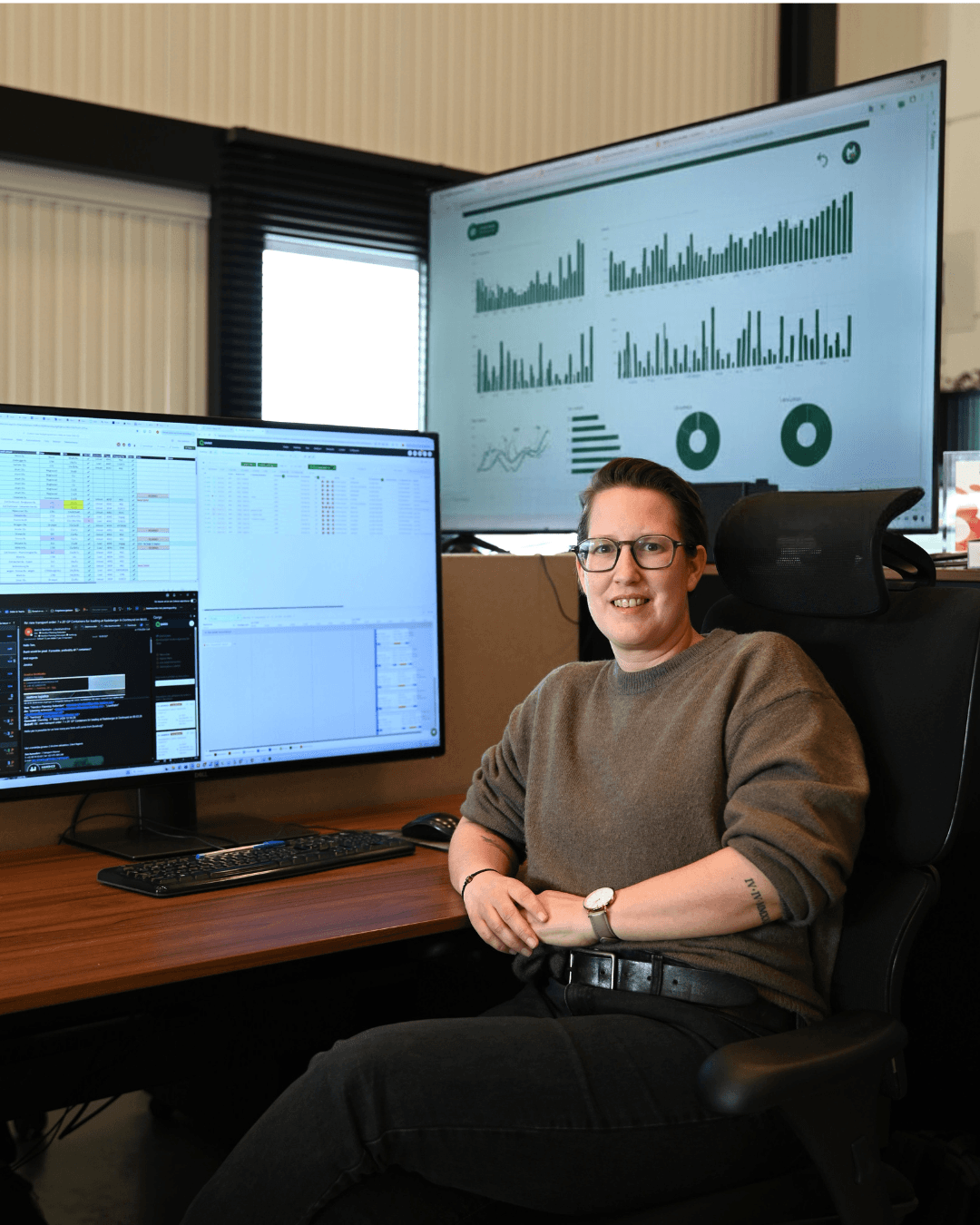
Ellen is one of the planners of Planning Antwerp at Handico Trucking. She has been with the team for nine years and is one of the longest-serving employees at Handico. It’s safe to say she knows a thing or two about planning. When the port gets busy, she keeps everything under control. Trucks stay on schedule, arrival times stay realistic, and small problems don’t become big ones. She combines updates from drivers, what’s happening at the terminal, what the customer needs, and which trucks are available so your transport keeps running smoothly.
A Day in the Life of Ellen, a Transport planner for planning Antwerp
Smooth container transport rarely feels like an achievement. When things stay calm, it’s usually because someone has been quietly connecting the dots: terminal slots, driver progress, special equipment, customer constraints, and real-time updates. This is what that work looks like through a typical day with Ellen, part of Handico’s Antwerp planning team.
07:00 — The Port Is Waking Up. Ellen Is Already Thinking About Tomorrow.
At 07:00, Ellen logs in, and her first instinct isn’t start planning.
It’s this: make sure tomorrow won’t start with gaps.
Because missing information doesn’t just create admin work. It creates waiting time. And waiting time is what customers feel: missed time windows, shifting ETAs, extra calls and extra stress.
So Ellen scans tomorrow’s orders and starts chasing the details that must be correct before a truck moves:
- A pickup reference that’s still unknown
- A customs document missing
- A time window not confirmed
- A container that is still not unloaded from the vessel
If you ever receive an email that feels “early,” that’s intentional. It’s the unglamorous work that prevents tomorrow from becoming a challenging day. By requesting the missing information as early as 07:00, we can already prepare everything for the customer service team when they come in at 08:30.
07:30 — Are All Trucks Running on Time?
By 07:30, the focus shifts to tomorrows’ planning. Ellen opens the full overview and does a fast reality check:
- How many trips are on the board?
- How many are long-distance?
- How many need special handling?
It’s the first risk scan of the day, because not every trip is equal. A local port move is one thing. A long-distance run that ties up a truck for most of the day is another. And special transports like reefers or ADR shipments can’t be solved last-minute with “any truck that’s free.”
So Ellen asks the critical question: Do we have enough suitable trucks for what’s coming? If the answer is “maybe not,” she starts securing extra capacity early, while there’s still room to maneuver. That’s often the difference between a controlled day and a panicked one.
At the same time, the first driver updates are coming in:
- “Left on time.”
- “The terminal is busy.”
- “I’m already waiting.”
- “Traffic jam.”
Ellen checks whether everything is starting on time and flags issues immediately:
- Which trucks are running as planned?
- Where is the first waiting time building up?
- Which trips are at risk of slipping?
If delays appear, speed matters: inform the customer as early as possible, because early notice creates options. This is also the moment when Ellen can already make quick adjustments to protect the schedule:
- swapping trips between trucks
- shifting time slots before they become missed appointments
And there’s another 07:30 reality: some drivers are already completing early drop-offs. They don’t wait around, Ellen sends their next instructions right away so capacity stays productive and the day keeps moving.
08:30 — The Second Shift Arrives: Ellen Keeps Planning, the Other Planner Follows Up
At 08:30, the second shift arrives, and the operation becomes faster and more responsive.
Now there are two planners with a clear split:
- Ellen keeps building and optimizing the planning
- the second planner focuses on follow-up, handling the constant incoming flow:
- Customer questions
- Driver messages and practical problems
- Order updates
- Issues that must be solved now, not later
This overlap is one of the reasons Handico can respond quickly without sacrificing overall control of the plan.
9:00 - 10:00 — First Trips Go Out
By 9:00, Ellen has collected enough real operational input to start committing the plan.
This is when she begins sending out the first trips, most of the time the ones that require extra attention like special cargo or long trips.
Because by now, there is much more certainty about:
- which trucks are truly on schedule
- where terminal waiting times are real
- which jobs need priority to avoid delays
Planning isn’t just “assign a truck.” It can include extra steps like scanning and physical checks, Customs stop,… So the earlier these moves are dispatched correctly, the smoother the rest of the day becomes.
11:30–11:45 — The Time-Out Session (Antwerp × Rotterdam Alignment)
Between 11:30 and 11:45, there’s a structured time-out session with colleagues across Antwerp and Rotterdam.
This is a key coordination moment to:
- align import vs. export flows
- review volumes and the number of trips
- share constraints, risks, and opportunities
- ensure everyone is working from the same operational picture
This short daily alignment improves communication, prevents double work, and strengthens teamwork between both port teams.
Midday — More Information Comes In, Most Trips Get Planned and Dispatched
Around midday, the operation produces even more facts, meaning Ellen can plan and dispatch the majority of remaining trips with higher confidence.
Then, gradually, the job shifts from “planning” to “control tower”:
- Monitoring whether execution is still matching the plan
- Intervening early when it’s not
- Switching tasks between trucks when needed
- Minimizing ripple effects when disruptions happen
The craft is not avoiding problems entirely, it’s keeping them small.
15:30 — The Handover: Structured Continuity
At 15:30, Ellen’s early shift wraps up, but the operation continues.
So she does a clear, structured handover:
- what’s completed
- what’s still moving (with current ETAs)
- which issues are active
- what actions have already been taken
- what still needs follow-up
The second shift then continues, waits for the last driver updates to come in, and plans the final remaining trips accordingly so nothing gets dropped and no one has to guess what happened earlier.
17:00 — Shift 2 Ends… Then On-Call Takes Over
Shift 2 runs until 17:00. After that, there is evening on-call coverage.
Because logistics doesn’t always stop at office hours. If something urgent happens late:
- A driver has a problem and needs a decision
- A time window becomes threatened
…the point is simple: don’t park the issue until tomorrow, when it’s already too late.
On-call exists for one reason: keep the operation flowing and prevent a messy start the next morning.
What This Structure Delivers (Without You Having to Think About It)
This planning day can be intense. but the structure is designed so customers feel the opposite:
- fewer surprises
- stable ETAs
- fast answers
- smart replanning when things change
- continuity throughout the day
- urgent support beyond office hours
When your container move feels “easy,” that’s not luck.
That’s Ellen and the rest of Team Antwerp doing the job quietly in the background.


